1. Pick a florist that actually delivers in China
The single biggest factor in whether your flowers arrive fresh is who arranges them. Relay services take your order in English, then pass it to a third-party wire network or ship a boxed bouquet across the country — adding markup, delay, and wilted stems. A florist with its own local network, like enflowers.com, routes your order to a vetted shop in the recipient's city, so the bouquet is made the same morning it's delivered.
Before you buy, check three things. First, pricing in USD: the final price should be visible at checkout, with no surprise conversion fees. Second, real reviews: look for independent reviews on Trustpilot or Google from overseas senders, not just testimonials on the site itself. Third, named delivery cities: a service that lists Beijing, Shanghai, Chengdu, and hundreds of smaller cities by name almost certainly has florists on the ground; one that just says “we deliver anywhere in China” usually doesn't.
2. Choose flowers that fit Chinese culture
Flower symbolism in China is specific, and getting it wrong can turn a kind gesture into an awkward one. The safe picks: red and pink roses for love, lilies (百合, whose name echoes “a hundred years of union” — a wedding favorite), mixed bright bouquets for birthdays, and peonies (牡丹), the “king of flowers,” which symbolize wealth and good fortune.
What to avoid: white or yellow chrysanthemums are funeral flowers, full stop — never send them for a celebration. All-white arrangements read as mournful for happy occasions. The number 4 sounds like “death” in Chinese, so avoid four-stem arrangements; 6, 8, and 9 are lucky counts. And while it's not about flowers, never pair your bouquet with a clock (送钟 sounds like attending a funeral) or a hat as an add-on gift.
When in doubt, choose red or pink. Red is the color of luck and celebration in China, and a red-forward bouquet is culturally safe for nearly every occasion except funerals.
3. Get the address right
Chinese addresses run in the opposite order from Western ones: largest to smallest — province, city, district, street, building, then apartment number. A Shanghai address looks like 上海市静安区南京西路1266号恒隆广场46层 (Jing'an District, 1266 Nanjing West Road, Plaza 66, 46th floor). Mixing the order up is the most common reason deliveries fail.
The safest approach is to paste the address in Chinese characters. Ask your recipient to send it to you, or copy it from Baidu Maps or Amap. English transliterations of street names are often ambiguous — several streets in the same city can romanize identically. enflowers.com's checkout fully supports Chinese input, so you can paste it directly.
Finally: the recipient's mobile phone number is essential. Chinese mobile numbers are 11 digits and start with 1 (e.g., 138-xxxx-xxxx). The courier will call before heading over, and without a working number, delivery can stall even with a perfect address.
4. Time zones and cut-off times
All of China keeps a single time zone: China Standard Time, UTC+8. That's 12–13 hours ahead of the US East Coast, 7–8 hours ahead of the UK, and 2–3 hours behind Sydney. When it's 9 PM in New York, it's already 9–10 AM the next morning in Beijing.
For same-day delivery, order by 2 PM China time. Orders after the cut-off arrive the next day. The time-zone math actually works in your favor: ordering from the US or Europe in your evening usually means the bouquet is arranged and delivered the following morning in China.
Watch the calendar. Chinese New Year (late January or February), Qixi Festival (Chinese Valentine's Day, in August), Valentine's Day, and Mother's Day (second Sunday of May, also observed in China) all spike demand sharply. Order three to five days early for these dates — florists sell out of popular stems and delivery windows widen.
5. What happens on delivery day
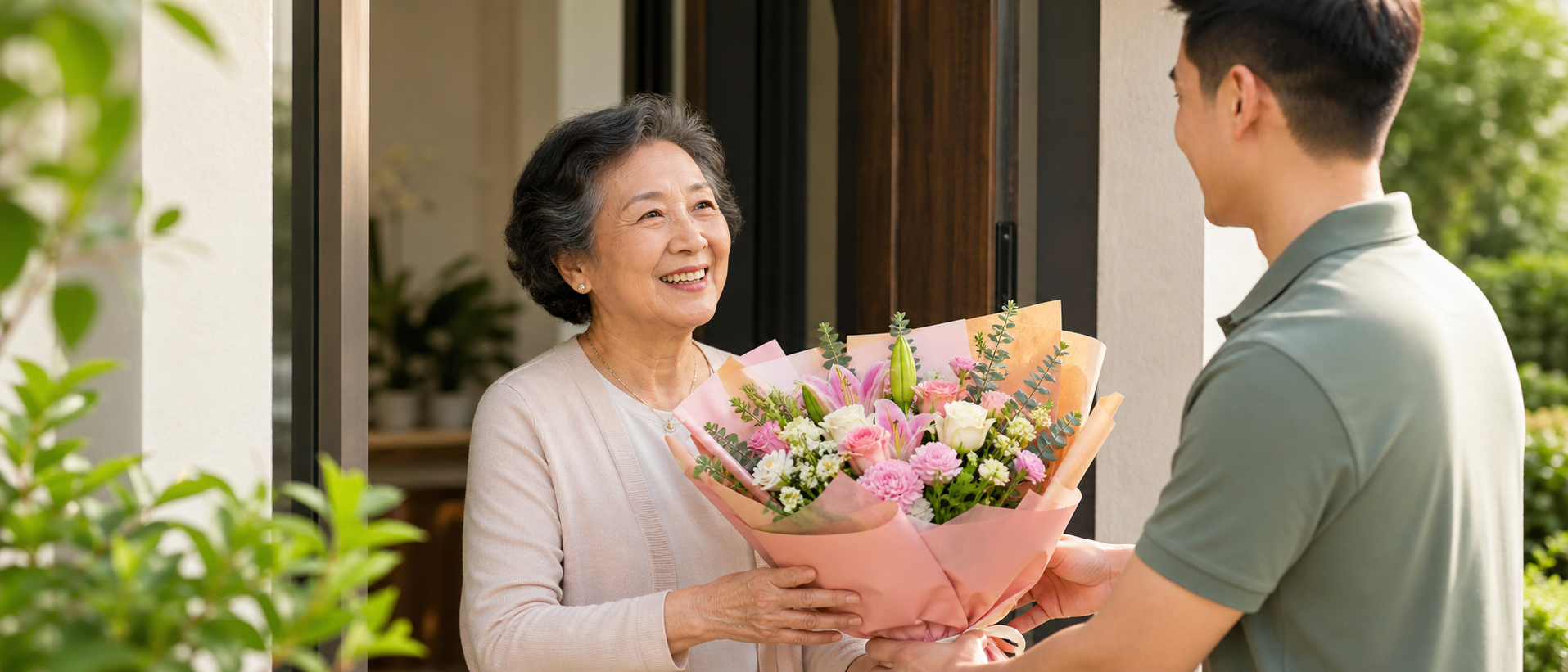
On the morning of delivery, the local florist arranges your bouquet fresh and hands it to a courier. Before setting out, the courier calls the recipient's mobile to confirm someone will be there — this is standard practice in China, and why that phone number matters so much.
If nobody answers the door, there's no failed-delivery drama: the courier calls again, can leave the bouquet with a neighbor, the building's front desk, or the property management office (a very common arrangement in Chinese apartment compounds), or comes back later. Re-delivery is free.
Once the bouquet is handed over, you get an English confirmation email, and you can request a photo of the delivered flowers — so even from 6,000 miles away, you see exactly what arrived at their door.